
A Guide to Formulate Hand Dishwashing Liquids That Meet Global Quality Standards
author: R&D Bella/ Jul. 31, 2026
Introduction
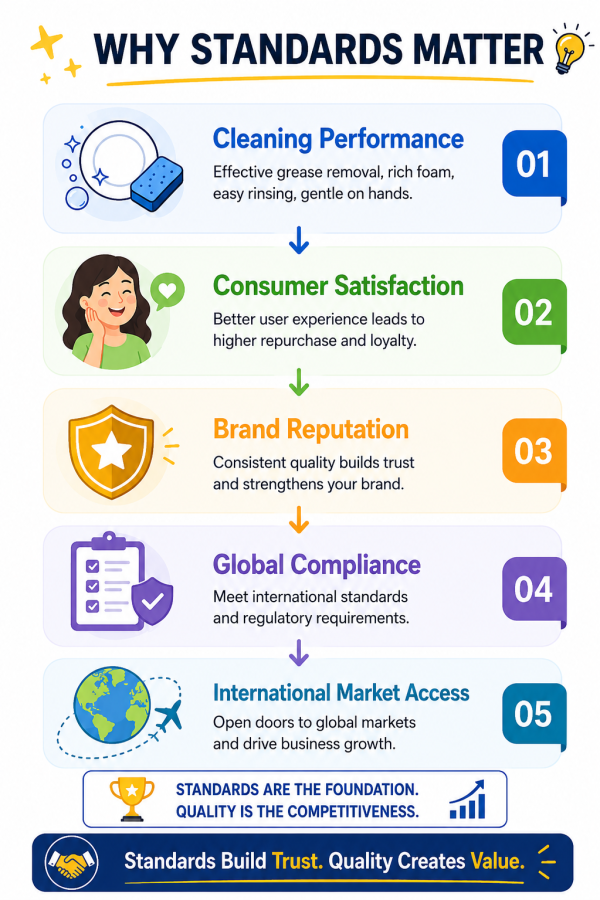
To consumers, a good dishwashing liquid should remove grease quickly, produce rich foam, rinse easily, and be gentle on the hands. However, brand owners, OEM manufacturers, and international buyers focus on long-term product stability, compliance with international regulations, environmental requirements, and consumer experience. Competition has evolved from simply ‘cleaning well’ to delivering comprehensive product quality. Entry into global markets depends not only on cleaning performance, but also on compliance with global quality standards, regulatory requirements, and sustainability trends.
1.A Great Dishwashing Liquid Is More Than Just Strong Grease Removal
As consumer expectations continue to evolve, a modern hand dishwashing liquid is expected to deliver far more than effective grease removal. Consumers increasingly value product safety, skin mildness, environmental sustainability, and consistent product quality, while regulatory and market requirements continue to differ across regions. For example, Europe emphasizes biodegradability, North America focuses on label compliance, the Middle East prefers Halal-certified ingredients, and Southeast Asia places greater importance on cost performance.
At the same time, global regulations and industry standards are becoming increasingly stringent. Modern hand dishwashing liquids must not only provide excellent cleaning performance but also meet higher expectations for safety, stability, sustainability, and international regulatory compliance.
A high-quality dishwashing liquid should therefore combine excellent grease removal, rich and stable foam, easy rinsing, skin mildness, product clarity, biodegradability, and compliance with international standards.
Ultimately, consumers seek a superior cleaning experience, while brand owners and OEM manufacturers look for reliable products that consistently meet global quality standards and evolving market requirements.
For formulation specialists, a thorough understanding of global quality standards is essential for developing competitive products and helping companies gain access to international markets.
What Are the Key Quality Indicators in the Global Dishwashing Liquid Market?
• Cleaning Performance
• Foam Performance
• Rinsability
• Appearance and Appealing Product
• pH & Mildness
For brand owners, OEM manufacturers, and international buyers, these key quality indicators not only determine product performance but also influence brand reputation, customer satisfaction, and a product’s ability to compete successfully in global markets.
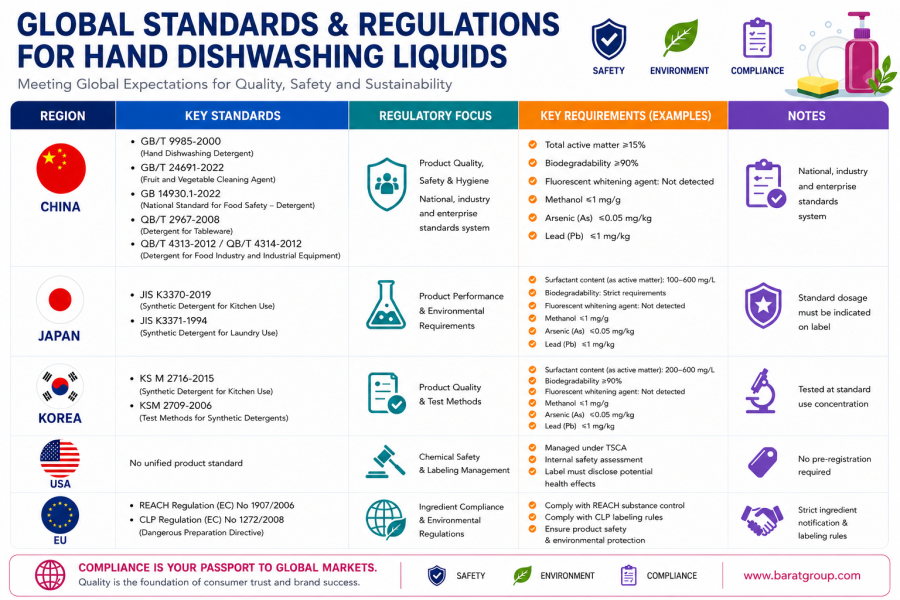
Global Regulatory Standards for Dishwashing Liquids:
Japan’s standards are primarily established by the Japanese Industrial Standards Committee (JISC), which has developed comprehensive quality standards for a wide range of detergent products, including synthetic detergents, kitchen detergents, soaps, and laundry soaps. Key standards include JIS K3370:2019 – Synthetic Kitchen Detergents and JIS K3371:1994 – Synthetic Laundry Detergents.
In South Korea, dishwashing liquids are mainly regulated by the Korean Standards Association (KSA) through product specifications and standardized testing methods. Relevant standards include KS M2716:2015 – Synthetic Kitchen Detergents and KS M2709:2006 – Test Methods for Synthetic Detergents.
China’s regulatory framework consists of national standards, industry standards, and enterprise standards, covering product specifications, testing methods, safety and hygiene requirements, as well as quality management. Together, these standards provide comprehensive guidance for the production and quality control of dishwashing liquids
The United States does not have a unified national product quality standard for dishwashing liquids, and products generally do not require pre-market registration before being manufactured. Instead, product safety is managed through ingredient safety assessments, regulatory control of chemical substances, and standardized product labeling to inform consumers of potential health risks. Chemical substances are regulated under the Toxic Substances Control Act (TSCA).
The European Union regulates dishwashing liquids primarily through chemical ingredient control and product labeling requirements. Chemical substances are managed under the European Inventory of Existing Commercial Chemical Substances (EINECS) and other relevant EU chemical regulations. Product safety and labeling requirements are also governed by legislation such as the Dangerous Preparations Directive (DPD), ensuring that detergent products meet strict safety and environmental standards before entering the European market.
Key Quality Indicators Across Global Markets
1.Total Active Matter (TAM)
Total Active Matter (TAM) is mainly derived from the surfactants used in dishwashing liquids. It is a core indicator of cleaning and grease-removal performance. In general, the higher the total active matter content, the stronger the cleaning performance. In China, the recommended national standard sets a requirement based on the percentage of surfactants in the finished product, with hand dishwashing liquids required to contain ≥15% total active matter. In Japan and South Korea, the requirement is expressed as a surfactant equivalent concentration. The standard usage amount must also be stated on the product label. South Korea requires 200–600 mg/L, while Japan requires 100–600 mg/L.
2.Biodegradability
China, Japan, and South Korea all include biodegradability requirements for surfactants, with Japan applying stricter requirements. China and South Korea both require ≥90% biodegradability. However, China lists this mainly as a raw material requirement, while Japan and South Korea include it as part of the physicochemical quality indicators.
3.Fluorescent Whitening Agents
Under global quality standards for dishwashing liquids, fluorescent whitening agents must not be detected.
4.Methanol
China has established safety limits and testing methods for methanol. Japan and South Korea also regulate methanol, with safety limits of ≤1 mg/g, which is consistent with China’s GB/T 9985-2000 Hand Dishwashing Detergent standard.
BARAT OLEOCHEM adopts Low-Temperature High-Vacuum Purification Technology</strong >, enabling its core products CDEA and CMMEA to maintain extremely low methanol residue levels of ≤20 ppm. This feature helps meet the safety and regulatory requirements of high-standard markets such as Japan and North America, and has been widely applied in customized formulation systems for international brands.
5.Arsenic and Heavy Metals
China, Japan, and South Korea regulate arsenic and heavy metals based on As and Pb content, although the testing concentrations differ.
In Japan, at a test concentration of 6.7 g/L, arsenic must be ≤0.05 mg/kg and heavy metals as Pb must be ≤1 mg/kg. In South Korea, at the standard usage concentration stated on the product label, arsenic must be ≤0.05 mg/kg and heavy metals as Pb must be ≤1 mg/kg. In China, according to GB/T 9985-2000, when tested as a 1% aqueous solution, arsenic must be ≤0.05 mg/kg and heavy metals as Pb must be ≤1 mg/kg.
Sustainability Has Become the New Global Standard
A comparison of global quality standards shows that the key performance requirements for dishwashing liquids are generally similar across major markets. However, the regulatory approaches differ.
Developed markets such as the European Union and the United States place greater emphasis on ensuring product safety through comprehensive regulations governing chemical ingredients, product safety, and labeling requirements. Japan adopts an even more stringent approach by combining product quality standards with detailed legislation to achieve a highly consistent regulatory framework. China has established a comprehensive system of product quality and safety standards, although its supporting regulatory framework is still evolving compared with some developed markets.
At the same time, global market expectations are shifting beyond product performance. Increasing attention is being given to biodegradability, renewable raw materials, carbon footprint reduction, and regulatory compliance. As a result, Lauric-Based surfactants derived from renewable vegetable oils have become a preferred choice for modern dishwashing liquid formulations. These ingredients offer an excellent balance of cleaning efficiency, skin mildness, and environmental sustainability, making them an increasingly important solution for manufacturers serving global markets.
How Minor Ingredients Make the Real Difference
A high-performance dishwashing liquid is not built on a single outstanding ingredient, but on the synergy of the entire formulation system. Every component plays a specific role in determining the final product quality. For example, chelating agents improve cleaning performance in hard water, pH adjusters influence product clarity, viscosity, preservative efficacy, and overall formulation stability, preservatives determine shelf life, while solvents affect grease-removal efficiency and the overall user experience.
Case Study
A transparent dishwashing liquid may appear crystal clear when it leaves the factory, but gradually become hazy or cloudy during storage. In many cases, this is not caused by the surfactants, but rather by changes in the compatibility between the pH level, fragrance, preservatives, and other formulation additives.
For this reason, professional manufacturers carefully optimize and validate the optimal pH range, high- and low-temperature stability, long-term clarity, and preservative compatibility before scaling up production.
For export products, it is recommended to complete temperature cycling tests, long-term storage stability tests, hard water compatibility tests, and packaging compatibility tests prior to commercial production. These evaluations help ensure consistent product performance across different climates, transportation conditions, and international markets.
Future Trends in Global Dishwashing Detergents
Future hand dishwashing liquids will focus on achieving the optimal balance between performance and sustainability. In addition to delivering powerful grease removal, rich and stable foam, fast rinsing, product clarity, and skin mildness, formulations will increasingly emphasize biodegradability, regulatory compliance, and environmental responsibility.
For global brands, sustainability is no longer simply an environmental initiative—it has become a key competitive advantage and an essential requirement for entering international supply chains. Manufacturers that can develop high-performance, sustainable, and globally compliant formulations will be better positioned to meet evolving consumer expectations and succeed in global markets.
BARAT Technical Insight
At BARAT Oleochem, we believe that an internationally competitive hand dishwashing liquid is not built around a single high-performance surfactant, but on a scientifically balanced and synergistic formulation system.
From primary surfactants, amphoteric surfactants, and foam boosters to chelating agents, pH adjusters, preservatives, and functional additives, every ingredient contributes to the product’s cleaning performance, clarity, stability, user experience, and regulatory compliance.
BARAT offers a comprehensive portfolio of Lauric-Based surfactants and functional additives, including CAPB, CMMEA, Amine Oxide, and CDEA, to support hand dishwashing liquid formulations with enhanced foam generation, foam stability, skin mildness, viscosity building, and grease-removal performance.
With extensive application expertise and a commitment to quality, BARAT helps customers develop high-performance, sustainable, and globally compliant formulations that meet the evolving demands of international markets.
Conclusion
Modern hand dishwashing liquids have evolved beyond simply delivering effective cleaning. Today, they are expected to achieve the right balance between cleaning performance, safety, skin mildness, product stability, environmental sustainability, and regulatory compliance . For manufacturers, understanding global quality standards and integrating these principles into formulation development is essential for enhancing international competitiveness and expanding into global markets.
At BARAT Oleochem, we supply a comprehensive portfolio of Lauric-Based surfactants and functional additives, including CAPB, CMMEA, Amine Oxide, and CDEA, to support a wide range of home care, personal care, and industrial cleaning applications.
Leveraging Malaysia’s abundant renewable vegetable oil resources, combined with advanced application expertise and formulation know-how, BARAT delivers end-to-end solutions covering raw material selection, formulation optimization, technical support, and international regulatory compliance. We help customers develop high-performance, sustainable, and globally competitive products that meet the evolving demands of international markets.
BARAT Oleochem — Your Trusted Lauric-Based Surfactant Partner.