
Choosing the Right Ingredients for High-Performance Blood Stain Laundry Detergents : From Protease to Formulation Design, Understanding Modern Blood Stain Removal Technology
author: R&D Bella/ Sept. 07, 2026
Introduction
In recent years, growing consumer awareness of personal hygiene, feminine care, baby care, and delicate fabric care has driven rapid growth in the underwear laundry detergent market. Compared with conventional laundry detergents, consumers now expect more than just effective cleaning. Consumers are also increasingly concerned about multiple performance aspects, including effective blood stain removal, fabric care, skin mildness, low-temperature washing performance, antibacterial protection, and long-lasting freshness.
Among these performance requirements, blood stain removal has become one of the most important features influencing consumers’ purchasing decisions. However, many users still experience the same frustration: Why can some underwear laundry detergents remove blood stains easily, while others leave stubborn stains even after repeated washing? The answer is not simply stronger cleaning power. Instead, it lies in the irreversible changes that occur within blood proteins over time.
1. Why Are Blood Stains So Difficult to Remove?
Blood stains are a typical type of protein-based stain. Unlike ordinary household dirt, blood is a complex biological material consisting primarily of:
- Hemoglobin
- Albumin
- Globulins
- Lipids
- Iron ions
- Mineral salts
Among these components, proteins are the primary reason why blood stains become increasingly difficult to remove. Fresh blood proteins remain highly water-soluble and can usually be removed by rinsing with cold water. However, prolonged exposure to air and elevated temperatures causes iron ions within hemoglobin to oxidize. At the same time, proteins begin to denature, coagulate, and cross-link with textile fibers, eventually forming aged blood stains that adhere firmly to fabrics.
Consequently, the longer a blood stain remains on fabric, the more difficult it becomes to remove. Unlike oily soils, protein-based stains continue to change over time. This is why professional textile care specialists consistently recommend treating fresh blood stains immediately with cold water, while avoiding hot water that accelerates protein coagulation.
2. Why Conventional Laundry Detergents Often Fail to Remove Blood Stains
Traditional liquid laundry detergents rely primarily on surfactants for cleaning. Many consumers assume that poor blood stain removal simply means the detergent contains insufficient active ingredients. In reality, this is not the case.
Surfactants work by reducing surface tension, emulsifying oils, and dispersing soils, making them highly effective for removing sebum, grease, and particulate dirt. However, once blood proteins have coagulated, surfactants alone have limited ability to break down the stain.
BARAT R&D testing demonstrates that even increasing surfactant concentration cannot effectively remove aged protein-based stains using a conventional surfactant system alone. This finding closely reflects the real-world experiences of many consumers. For this reason, modern premium underwear laundry detergents increasingly employ enzyme-surfactant systems, combining protease technology with optimized surfactant formulations.
3. Why Has Protease Become the Core Ingredient in Modern Blood Stain Removal?
Protease is one of the most widely used and effective detergent enzymes for removing protein-based stains. Rather than simply washing away blood, protease catalyzes the hydrolysis of proteins, breaking large protein molecules into smaller peptides and amino acids that dissolve more readily in water and can then be removed by surfactants.
To identify the most effective enzyme for blood stain removal, BARAT R&D evaluated multiple commercially available detergent enzymes using a standardized detergent base containing 15% active matter.
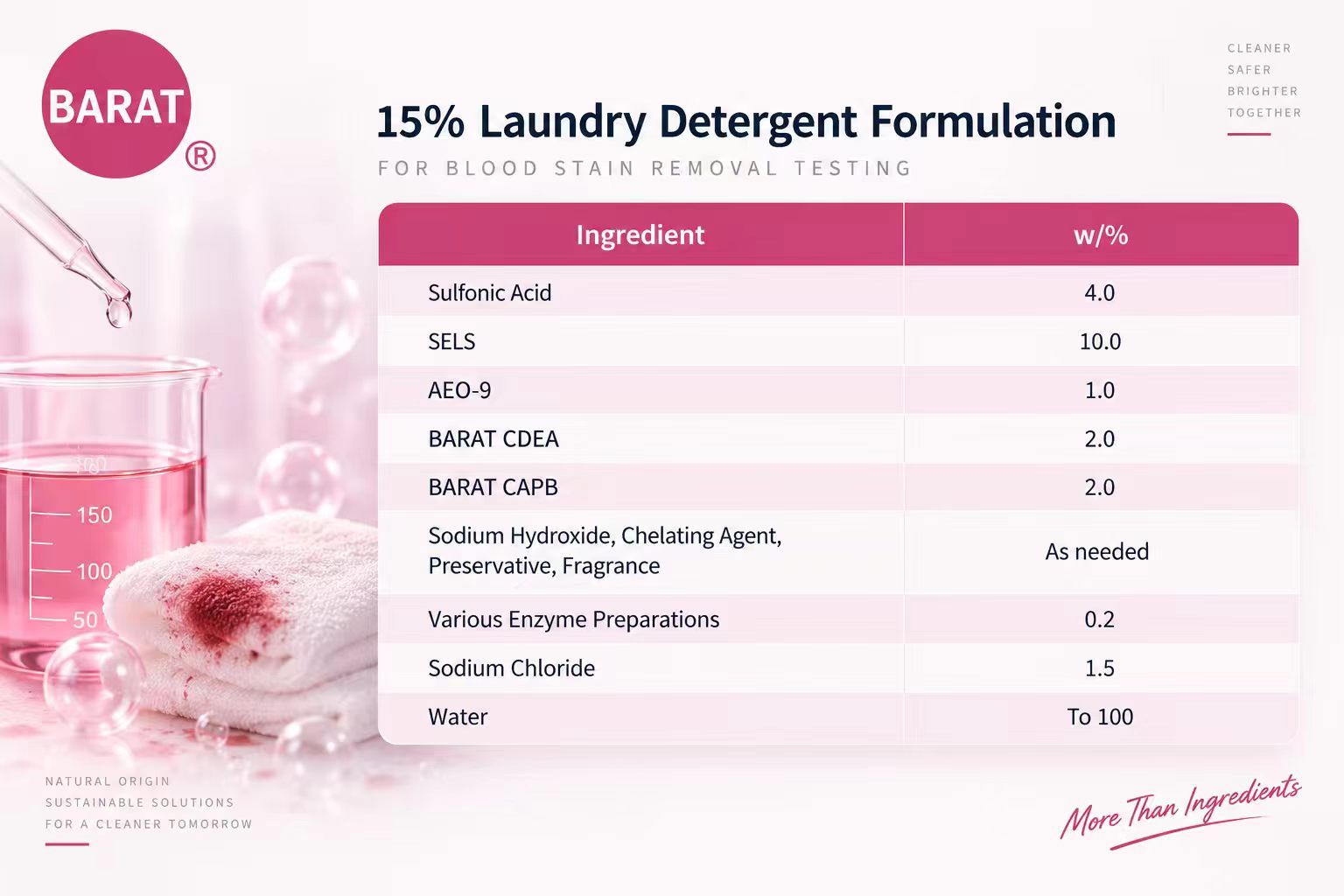
The study found that:
- Different enzymes exhibited significantly different blood stain removal performance.
- Protease consistently delivered the best cleaning results.
- Protease does not directly ‘wash away’ blood; it catalyzes protein hydrolysis, converting large protein molecules into smaller, more soluble fragments.
- Blood-stained fabrics made with animal blood showed similar test results.
These results clearly indicate that selecting the appropriate protease is considerably more effective than simply increasing surfactant dosage when removing protein-based stains.
4. Is More Protease Always Better?
Many formulation engineers assume that increasing protease dosage will continuously improve blood stain removal. However, BARAT R&D obtained different results.
Protease concentrations of 0.1%, 0.2%, 0.3%, 0.4%, and 0.5% were evaluated using standardized blood-stained and protein-stained fabrics.
- Cleaning performance improved significantly as protease dosage increased.
- Performance gains became much smaller once dosage exceeded 0.3%.
- Considering both cleaning efficiency and formulation cost, 0.2% protease provided a good overall cost-performance balance.
This demonstrates that optimizing formulation design is often more valuable than simply increasing enzyme dosage.
5. Why Is Formulation Compatibility So Important?
Many formulators believe that adding protease alone is sufficient for excellent blood stain removal. In reality, protease is a biologically active protein whose performance depends heavily on formulation compatibility.
BARAT R&D further investigated the interaction between protease and several surfactant systems, including LABS, SELS, AEO-9, AOS, BARAT CDEA, and BARAT CAPB.
- LABS showed poor synergy with protease and inhibited protease activity.
- SELS, AEO-9, BARAT CDEA, and BARAT CAPB showed little or no inhibition toward protease.
- The EO groups in SELS had relatively little effect on protease; as the EO number increased, the impact on enzyme activity was further reduced.
These findings demonstrate that formulation success depends not only on selecting high-quality ingredients, but also on ensuring excellent compatibility between them.
6. Why Do Similar Formulations Deliver Different Blood Stain Removal Performance?
To further evaluate formulation effects, BARAT R&D prepared eight different surfactant systems, each containing 0.2% protease.
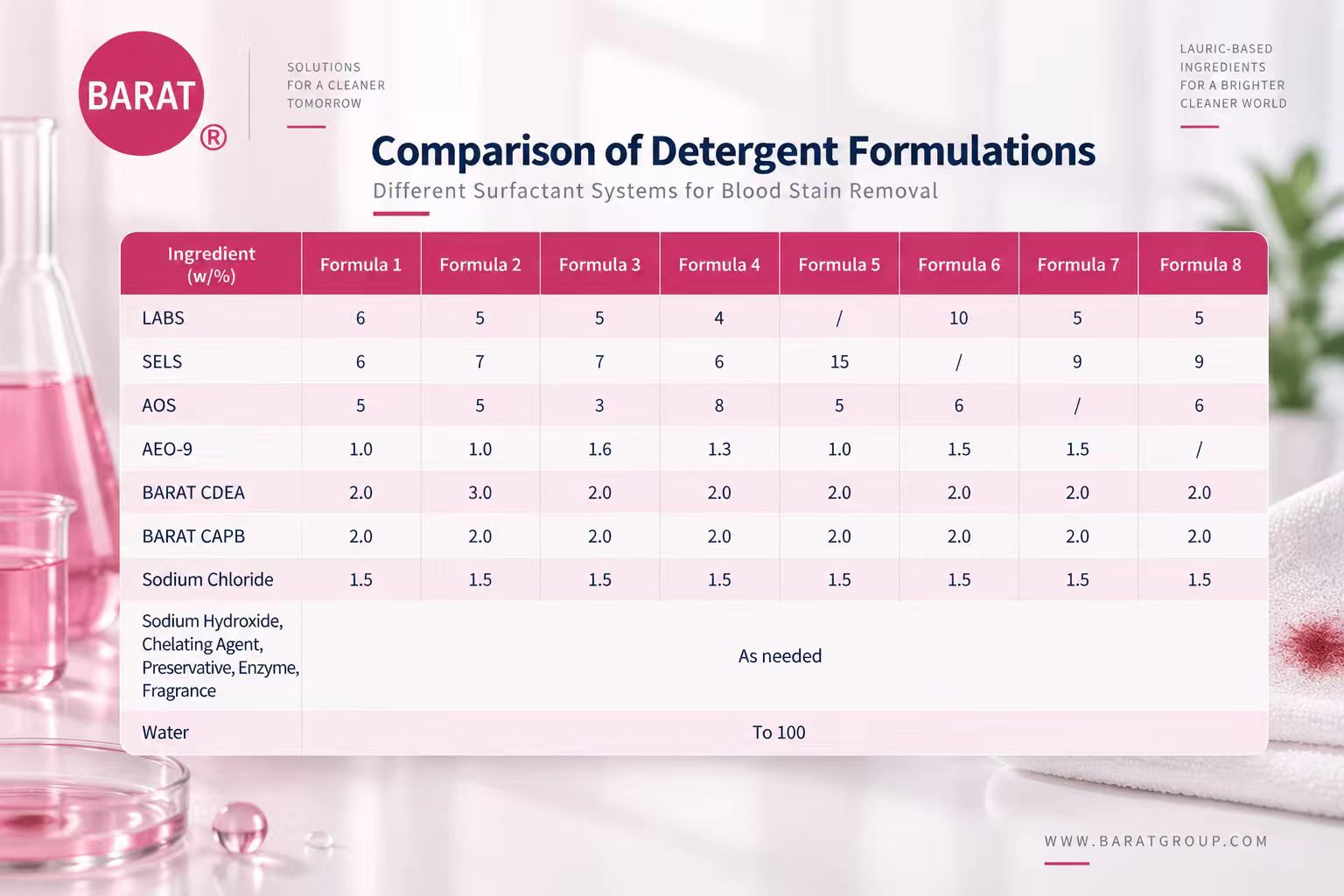
Experimental results showed:
- Formula 5 achieved the best blood stain removal performance.
- Formula 6 produced the weakest cleaning performance.
- The remaining formulations exhibited relatively minor differences.
Further analysis revealed that Formula 5 contained no LABS, allowing protease to maintain high enzymatic activity. In contrast, Formula 6 contained 10% LABS, resulting in significantly stronger enzyme inhibition and consequently poorer blood stain removal.
These findings demonstrate that blood stain removal depends not only on protease itself, but also on the overall formulation system, including anionic surfactants, amphoteric surfactants, nonionic ingredients, pH control, and functional additives. An outstanding blood stain detergent is therefore achieved through formulation synergy rather than reliance on any single ingredient.
7. BARAT Technical Insight
At BARAT, we believe that outstanding blood stain removal is never achieved by relying on a single ‘star ingredient.’ Instead, it results from the scientific synergy of the entire formulation.
- Protease catalyzes the breakdown of protein stains.
- Surfactants emulsify and disperse soils.
- BARAT CDEA and BARAT CAPB, as nonionic and amphoteric components, help improve formulation stability while maintaining good enzyme compatibility.
At the same time, proper control of pH, chelating systems, preservative systems, and storage stability is equally important for developing modern enzyme-based laundry detergents. An excellent formulation should deliver not only superior blood stain removal, but also gentle fabric care, long-term stability, and an outstanding consumer experience.
Future Trends
As green cleaning and low-carbon formulation technologies continue to develop, the next generation of high-performance blood stain laundry detergents will increasingly focus on:
- High-efficiency protein stain removal
- Low-temperature washing performance
- Gentle fabric and skin care
- Long-term enzyme stability
- Sustainable bio-based ingredients
- Safer and more environmentally responsible formulation design
These trends are driving continuous innovation throughout the home care industry. For formulation engineers, true product competitiveness depends not on a single ingredient, but on the scientific design and synergistic optimization of the entire formulation system.
BARAT Formulation Support
BARAT provides not only high-quality Lauric-Based surfactants, but also comprehensive formulation support for customers developing advanced cleaning products.
- Blood stain laundry detergent formulation recommendations
- Enzyme compatibility optimization
- Thickening solutions for underwear laundry detergents
- Formulation stability improvement
- Raw material application support
Whether you are developing a luxury premium underwear laundry detergent or optimizing an existing formulation, BARAT is ready to support your innovation with high-quality Lauric-Based ingredients and professional formulation expertise.
About BARAT
BARAT Oleochem specializes in high-quality Lauric-Based surfactants and specialty ingredients for Personal Care, Home Care, and Industrial Cleaning applications. With extensive expertise in formulation support, application development, and sustainable oleochemical solutions, BARAT is committed to helping customers worldwide develop high-performance, stable, and environmentally responsible cleaning products.